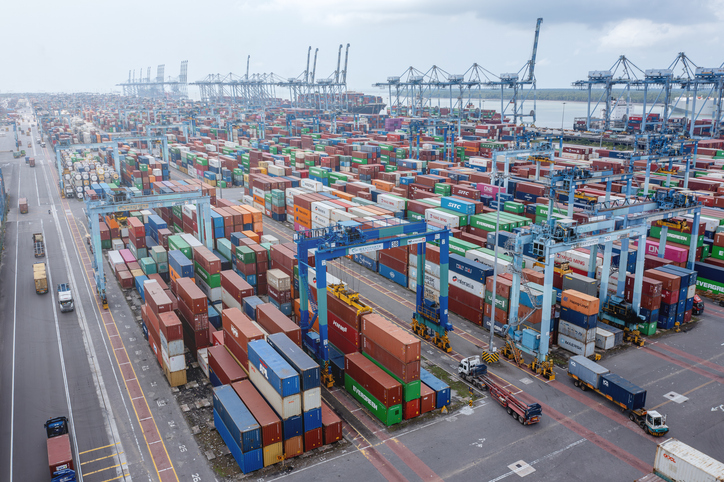
Drive outside Ho Chi Minh City, Jakarta, or Johor today, and you'll see a different kind of growth. Instead of towers, you'll find logistics parks filled with warehouses, distribution centers, and factories. E-commerce is reshaping Southeast Asia, and that growth is creating strong demand for industrial and logistics real estate. In many markets, these properties are attracting more investor attention than traditional office and retail assets.
What's Fueling Demand for Industrial Space?
Online shopping continues to grow across Indonesia, Vietnam, the Philippines, and Thailand. Every order needs to be stored, sorted, and delivered, creating demand for warehouses, distribution hubs, and last mile facilities.
Manufacturers are also changing how they think about their supply chains. Many companies are adopting a "China+1" strategy, expanding production into other countries to reduce their reliance on a single market. Vietnam has been one of the biggest beneficiaries, attracting manufacturers looking for competitive costs, established industrial parks, and strong connections to global supply chains (Nam Dinh Vu Industrial Park, April 2026).
Trade agreements are supporting this growth as well. RCEP and the ASEAN Free Trade Area make it easier to move goods across borders, supporting both manufacturing and regional distribution.
The region's growing middle class is another driver. As incomes rise, demand for consumer goods, fresh food, and online shopping increases. That creates a need for more distribution centers and cold storage facilities. Infrastructure is improving too. Better ports, highways, and rail connections are making it easier to move goods within countries and across borders.
Why Investors Are Choosing Industrial Over Other Property Types
Industrial real estate has been outperforming office and retail in several Southeast Asian markets. One reason is the stability that often comes with industrial leases. Manufacturing and logistics tenants typically sign longer term agreements, giving owners more predictable income.
E-commerce also has plenty of room to grow. Online shopping penetration across much of Southeast Asia remains below more mature markets in North America and Europe. As adoption increases, demand for logistics space should continue to follow. Regional investment outlooks also point to industrial, logistics, and data center assets as some of the strongest opportunities for long-term real estate investment (IQI Global, May 2026).
For investors, the region also offers diversification. Investing across several Southeast Asian markets can reduce exposure to a single economy or currency. REITs, funds, and sale-leaseback transactions are also creating more ways to access the sector without buying and managing a property directly.
Regional Hotspots and Market Snapshots
Vietnam has become a major manufacturing hub, with Hanoi, Ho Chi Minh City, and Binh Duong attracting significant foreign investment. Developers are responding with higher-quality industrial parks, improved infrastructure, and more sustainable facilities to meet the needs of global manufacturers (Nam Dinh Vu Industrial Park, April 2026).
Indonesia is seeing strong demand around Jakarta and Surabaya. These cities serve as important distribution hubs for one of the region's largest consumer markets. As domestic consumption grows, demand for warehouses and last-mile facilities near major population centers is expected to grow with it (Nexdigm).
Malaysia, particularly Johor and the Iskandar region, is benefiting from its proximity to Singapore. The Johor-Singapore Special Economic Zone, launched in January 2025, aims to strengthen cross-border trade and improve the movement of goods between the two markets (JLL, August 2025).
Iskandar Malaysia has already attracted major investment commitments from countries including the United States, China, Germany, Japan, and Singapore. The region is also becoming an important data center hub as Singapore faces growing constraints around land and power capacity (Malaysia4U, June 2026).
Where Challenges May Emerge
Industrial real estate depends heavily on infrastructure and tenant demand. A warehouse may look attractive on paper, but poor road access, limited power capacity, or delays at nearby ports can quickly affect its performance.
Tenant concentration is another factor to consider. A facility built for one large manufacturer or logistics company can be highly profitable, but it may be harder to lease if that tenant leaves. Investors should consider how easily a property can be adapted for another user.
Supply chain trends can also change. Companies may shift production to different countries as costs, tariffs, and trade policies evolve. Investors need to consider whether a location is positioned to benefit from these changes over the long term rather than simply following the latest wave of demand.
The Outlook for Southeast Asia
Southeast Asia's industrial real estate growth is being driven by several long-term trends. E-commerce is expanding, consumer spending is rising, global supply chains are diversifying, and governments continue to invest in infrastructure.
Over the next three to five years, we expect Vietnam to remain a key manufacturing market, Indonesia to strengthen its position as a major domestic distribution hub, and Johor to benefit from growing cross-border activity with Singapore. For investors looking to diversify into industrial real estate, Southeast Asia offers an increasingly compelling opportunity. At Global Genius Strategies, we're focused on identifying the markets and property types with the strongest long-term fundamentals and helping investors find opportunities that fit their goals. (GGS)